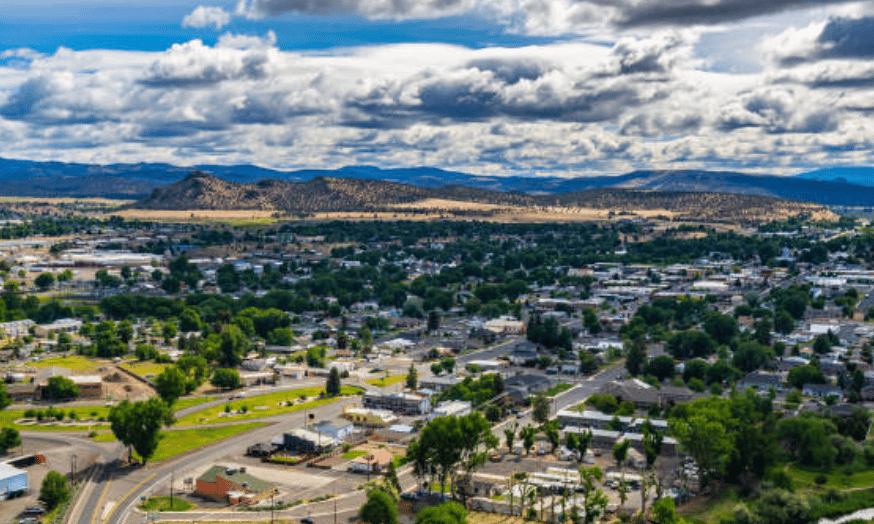
Ask most buyers what a rising housing market looks like and they will describe the same scene: multiple offers, waived inspections, a house gone in a week. Ask what a slowing market looks like and they will describe the opposite: price cuts, empty open houses, sellers getting nervous. Prineville is doing both at once, and that combination is the most useful thing a buyer or seller comparing Central Oregon towns can understand about this particular market right now.
Two Numbers That Aren't Supposed to Move Together
In February 2026, Prineville's median sales price reached $449,450, up 16.89 percent from $384,500 the year before. That was the strongest year-over-year appreciation of any tracked market in Central Oregon this year, faster than Bend, faster than Redmond, faster than Sisters. In a normal market, a number like that comes paired with speed: homes moving in days, buyers competing hard enough to push prices past asking. Instead, cumulative days on market in Prineville hit 127 days that same month, up 76 percent from 72 days the year before.
That pattern held through the summer. Over the three months ending June 2026, Prineville's median sale price sat at $429,000, up 4.6 percent from the same period a year earlier, while homes averaged 64 days on market compared to 45 days the year before. Sixty five homes closed in June, up from 60 the year before, so volume was not the problem. As of August 2026, the median list price sits at $450,000 across 77 active single-family listings, a market still climbing in price with no sign of the pace catching up.
Price per square foot tells the same story from a different angle. Mid-2026 closings have landed in the $255 to $293 per square foot range, a real increase from a year earlier, but nobody is describing Prineville listings as gone-in-a-weekend.
Why This Isn't a Normal Seller's Market
Rising prices paired with a slower pace usually means one of two things: the data is noisy, or the type of buyer showing up has changed. In Prineville's case, it's the second one.
The demand underneath this market is not speculative. It's not vacation buyers chasing appreciation or investors trying to time a cycle. It's employment. Meta and Apple both operate large data center campuses near Prineville, and the jobs those campuses have pulled into the local economy extend well past the buildings themselves. Nearly half of all jobs in Prineville are now connected to large industrial sites like these facilities, and the ecosystem around them keeps growing:
- Electricians and HVAC technicians maintaining the physical infrastructure
- Fiber-optic and network engineers supporting connectivity
- Security personnel and logistics operators
- Food service and other support businesses that relocate or expand to serve a growing workforce
These are salaried, long-term positions rather than seasonal or construction-cycle work, and that distinction matters more than it sounds. A buyer moving to Prineville because they took a job there is not trying to beat four other offers before their pre-approval expires. They tend to have financing lined up, they order the inspection, and they take the time to be sure before they close.
A market can post the strongest price growth in the region and still let a house sit for three or four months, if the buyers arriving are choosing the town for a paycheck rather than a hunch.
That is the mechanism worth understanding before comparing Prineville's numbers to a neighboring city's median and assuming they mean the same thing.
Prineville Next to Bend
Bend closed June 2026 at a median price of $725,000, up 4.6 percent year over year, with homes going pending in 15 days. Set that next to Prineville's own 4.6 percent gain over roughly the same window and the percentage growth looks identical. The pace does not.
Prineville | Bend | |
|---|---|---|
Median sale price (3 mo. ending June 2026) | $429,000 | $725,000 |
Year-over-year change | +4.6% | +4.6% |
Typical time to pending | 64 days | 15 days |
Same appreciation rate, four times the wait. Bend's growth is still running on urgency. Prineville's is running on need, and a market driven by need behaves differently than one driven by competition, even when the price charts look similar.
That pace difference is also the clearest sign that Prineville has not been fully discovered yet. Prices are catching up to what the local job market can support, but the buying process itself hasn't turned into the sprint it has become in Bend.
What the Price Gap Actually Buys
Housing in Prineville runs roughly 40 to 50 percent below Bend, and that gap shows up as real differences in what a similar budget can secure, not just a smaller version of the same house.
Brooks Resources built IronHorse as Prineville's first master-planned community specifically to offer more affordable homes and homesites, a direct response to the housing demand the data center economy created. A buyer looking for acreage instead has options like Indian Rock Estates and Longhorn Ridge, both offering five-acre homesites near BLM land with room for horses and genuine privacy, something that budget would not touch closer to Bend. Buyers who want to stay closer to downtown while still getting space tend to look at West Hills, where homes typically sit on at least an acre with some Cascade Range views and an easy drive to Prineville's own Main Street.
The point is not that Prineville is simply cheaper. It's that the same $450,000 median list price buys a genuinely different set of choices here than it does an hour away.
The Supply Question Still Ahead
Prineville has proposed a 750-acre urban growth boundary expansion tied to more than 2,700 projected jobs over the next 20 years. If that expansion moves forward, it opens new residential land to development in a market that has been running tight on inventory relative to its job growth.
For a buyer, that is a reason to look at what is available now rather than wait for that land to open. Established neighborhoods carry a head start over land that has not yet cleared the approval process. For a seller weighing whether to list this year or hold, it is worth knowing that the current slower pace is not a sign of weakening demand. It reflects careful buyers, not absent ones. Future supply from an expansion years out does not change what a well-priced home does today.
A Few Questions Worth Answering Directly
Does the slower pace mean sellers should expect price cuts to move a listing? Not based on what the data shows. Prices have kept climbing through 2026 even as days on market lengthened. A slower sale reflects buyers taking their time on financing and inspection, not a lack of buyers.
Is Prineville still worth considering given how much prices have already climbed this year? The appreciation has been real, but the underlying driver, stable employment tied to long-term industrial investment, is different from the kind of speculative run that tends to reverse quickly. That doesn't guarantee future performance, but it does mean the current pricing reflects something more durable than a temporary trend.
Prineville's numbers only make sense once you know who is actually buying and why. A market shaped by paychecks moves differently than one shaped by panic, even when the price chart looks the same either way. If you are weighing Prineville against Bend, Redmond, or another Central Oregon town and want to understand what your specific budget and timeline actually support here, Heather Osgood can walk through the current listings, the neighborhoods worth a closer look, and what the coming years of growth might mean for your decision. Let's Connect.